
TL;DR:
- Targeted paid advertising uses data to reach specific audiences with high intent, improving ROI.
- Privacy changes in 2026 require brands to adopt cookieless and contextual targeting strategies.
- Creative testing and human insights are essential for maximizing ad performance and understanding audience motivations.
Paid advertising has a reputation problem. Many marketing decision-makers still picture it as a numbers game: spend enough, reach enough people, and hope something sticks. That thinking belongs to a different era. Modern targeted paid advertising is built on data, precision, and intent. Whether you run an assisted living facility, an e-commerce brand, or a luxury experience business, the difference between campaigns that drain budget and campaigns that generate consistent, measurable returns comes down to one thing: who sees your ad, and why. This article breaks down exactly how targeted paid advertising works in 2026, what the mechanics look like, and how to build a strategy that actually performs.
Table of Contents
- Defining targeted paid advertising: The fundamentals
- How targeted paid advertising works in 2026
- Navigating privacy, cookies, and advanced targeting
- Creative excellence, testing, and future-proof strategy
- Beyond tech: The underestimated impact of human insight
- Next steps: Expert support for your ad growth
- Frequently asked questions
Key Takeaways
| Point | Details |
|---|---|
| Precision delivers ROI | Targeted paid advertising beats mass advertising by focusing spend on high-intent audiences. |
| Ad tech keeps evolving | Automation, first-party data, and privacy-first solutions are essential for campaign success in 2026. |
| Creative and testing win | The best campaigns prioritise compelling creative and robust ongoing testing. |
| Privacy reshapes strategy | Cookieless, consent-led, and contextual approaches are critical for compliance and performance. |
| Expertise drives results | Combining data, human insight, and sector know-how achieves the strongest outcomes. |
Defining targeted paid advertising: The fundamentals
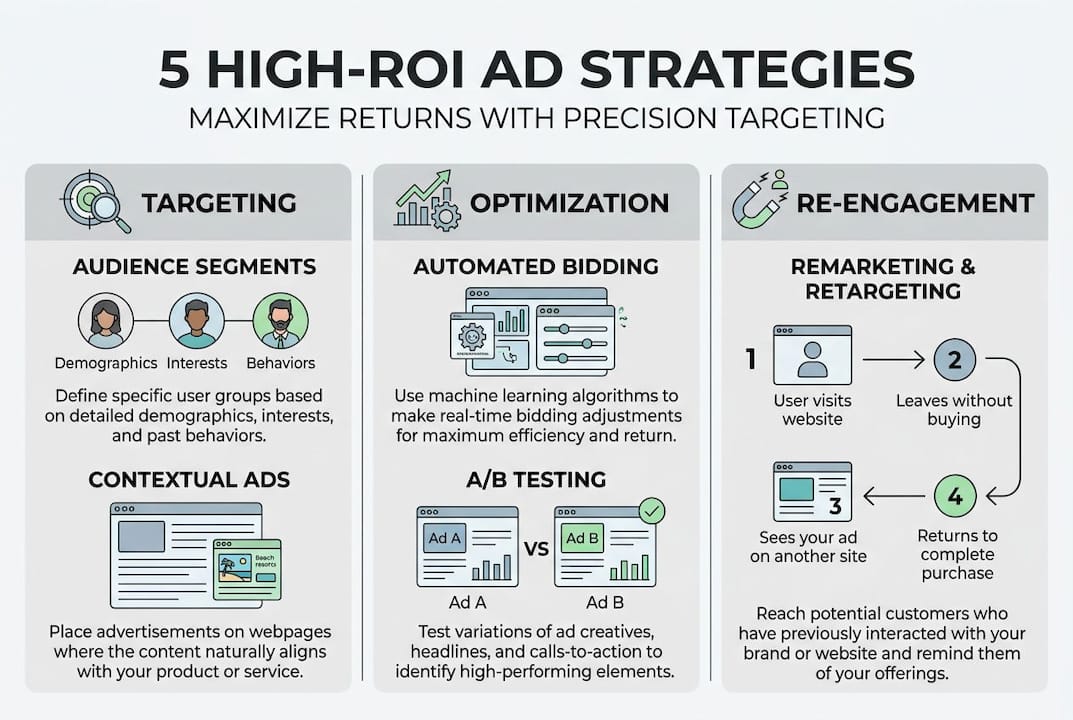
Targeted paid advertising is not simply running ads online. It means displaying your message to specific audiences selected using data points such as demographics, behaviour, interests, and location, rather than broadcasting to the widest possible group. As targeted advertising research confirms, this approach contrasts sharply with mass advertising, which prioritises reach over relevance.
The practical difference is significant. A luxury retreat targeting high-net-worth individuals aged 35 to 55 who have recently searched for wellness holidays will always outperform a generic display campaign shown to anyone browsing lifestyle content. Specificity is what drives paid advertising ROI from acceptable to exceptional.
“Targeted paid advertising uses data to display ads to the audiences most likely to take action, making every pound of budget work harder than any broad-reach alternative.”
There are three primary data sources that power targeting decisions:
- First-party data: Information you own, such as email lists, CRM records, and website visitor behaviour. This is your most valuable asset.
- Third-party data: Audience segments purchased from data providers, useful for prospecting but increasingly restricted under privacy regulations.
- Contextual targeting: Placing ads alongside relevant content rather than following individual users. Highly effective and privacy-compliant.
Here is how targeted paid advertising differs from broad paid advertising in practice:
- Broad ads reach large audiences with low intent; targeted ads reach smaller audiences with high intent.
- Broad campaigns optimise for impressions; targeted campaigns optimise for conversions.
- Broad approaches suit brand awareness at scale; targeted approaches suit direct response and lead generation.
- Targeted campaigns require more upfront strategy but deliver stronger returns over time.
Understanding business growth with paid ads starts with accepting that precision, not volume, is the foundation of modern paid strategy.
How targeted paid advertising works in 2026
With the fundamentals defined, it is critical to understand the machinery behind today’s targeted advertising. The landscape has shifted considerably, and the platforms, tools, and bidding models available in 2026 reward advertisers who understand how to use them properly.
Data collection, audience segmentation, and automated bidding now define how campaigns are structured and optimised. Google Ads, Meta (Facebook and Instagram), and programmatic platforms each offer distinct targeting capabilities, but all share the same core logic: show the right message to the right person at the right moment.

Automated bidding strategies have largely replaced manual cost-per-click management. Automated bidding outperforms manual CPC, with Performance Max campaigns requiring at least 50 conversions per month to function effectively. Target ROAS (return on ad spend) bidding tells the algorithm exactly what revenue outcome you want, and the system adjusts bids in real time across millions of signals.
| Platform | Key targeting options | Primary bidding model |
|---|---|---|
| Google Ads | Keywords, intent, in-market audiences, remarketing | Target ROAS, Performance Max |
| Meta (Facebook/Instagram) | Demographics, interests, lookalike audiences, behavioural | Cost per result, advantage+ |
| Programmatic (DSPs) | Contextual, behavioural, geographic, device | CPM, viewable CPM |
| LinkedIn Ads | Job title, industry, company size, seniority | Cost per click, cost per send |
To set up a targeted campaign correctly, follow this sequence:
- Define your conversion goal precisely (enquiry, purchase, booking, phone call).
- Build your audience segments using first-party data and platform tools.
- Select the platform that matches where your audience spends time.
- Choose an automated bidding strategy aligned to your conversion goal.
- Set a realistic budget that gives the algorithm enough data to optimise.
Pro Tip: Never launch a campaign without a clearly defined conversion event tracked in your ad account. Automated bidding is only as intelligent as the data you feed it. Platforms like Google need clean conversion signals to optimise effectively, especially for 2026 digital marketing trends such as AI-driven audience expansion.
Navigating privacy, cookies, and advanced targeting
The precision of targeted paid advertising faces new challenges with tightening privacy and tracking changes. GDPR in the UK and Europe, alongside CCPA in California, require explicit user consent before behavioural data can be collected. For marketing decision-makers, this is not a compliance headache to hand off to legal; it directly affects campaign performance.
Cookieless targeting uses first-party data, contextual methods, and server-side tracking to maintain campaign effectiveness while meeting regulatory requirements. The brands that are winning in 2026 are those that built robust consent management platforms (CMPs) and invested in server-side tracking infrastructure before the third-party cookie was fully deprecated.
Server-side tracking can recover 15 to 30% of lost ad signals, which translates directly into better automated bidding performance and more accurate attribution. That is a meaningful difference when you are managing significant monthly ad spend.
| Targeting method | Effectiveness | Privacy compliance | Best use case |
|---|---|---|---|
| Behavioural (cookie-based) | High | Restricted | Remarketing with consent |
| First-party data | Very high | Fully compliant | CRM audiences, email match |
| Contextual targeting | Moderate to high | Fully compliant | Prospecting, brand safety |
| Server-side tracking | High (signal recovery) | Compliant with setup | Conversion optimisation |
Contextual targeting, once considered a step backwards, has proven its value. Targeting case studies show it performs only 5 to 8% less effectively than behavioural targeting while carrying none of the consent risk. For assisted living facilities and luxury brands where audience trust is paramount, this matters enormously.
Adapting to privacy changes in advertising is not optional; it is the baseline for sustainable campaign performance in 2026.
Pro Tip: Deploy your consent management platform before Q2 2026 if you have not already, and run parallel tests comparing cookieless contextual campaigns against your standard behavioural campaigns. The data will surprise you.
Creative excellence, testing, and future-proof strategy
Technical precision is only part of the equation; creative and testing hold the final key. You can have the most sophisticated audience segmentation in your industry and still generate poor results if the ad itself fails to connect.
Creative drives 70% of ad performance, with testing periods of 7 to 14 days needed to generate statistically meaningful results. This is not a minor variable. It means that for most campaigns, the audience targeting and bidding strategy account for just 30% of what determines success. The image, headline, and emotional trigger in your ad are doing the heavy lifting.
Privacy-first creative approaches, such as emotionally resonant calls to action for senior living campaigns and well-structured asset groups for e-commerce, maintain strong ROAS even as tracking restrictions tighten. The creative carries the message when the data signals are reduced.
Creative best practices by audience type:
- Assisted living facilities: Lead with family reassurance and quality of care. Use real photography, warm tones, and testimonials. Emotional safety is the primary trigger.
- E-commerce brands: Prioritise product clarity, social proof, and urgency. Video creative consistently outperforms static for purchase-intent audiences.
- Luxury experience businesses: Aspirational imagery, minimal copy, and exclusivity signals. Your creative should feel like the experience itself.
For testing, follow this process:
- Isolate one variable per test (headline, image, CTA, or audience).
- Run each variant for a minimum of 7 days with sufficient budget for 100 or more conversions per variant.
- Measure against your primary conversion goal, not secondary metrics like click-through rate.
- Scale the winning variant and retire underperformers immediately.
- Begin the next test cycle without delay.
Building high-ROI creative strategies requires discipline. Most brands test too infrequently, run tests for too short a period, or change multiple variables simultaneously, which makes it impossible to know what actually drove the result.
Beyond tech: The underestimated impact of human insight
Automation and AI solve for efficiency. They optimise bids, expand audiences, and process data at a scale no human team could match. But they cannot tell you why a family choosing an assisted living facility is really driven by guilt as much as care quality. They cannot sense that a luxury client responds to scarcity language because their identity is tied to exclusivity. That level of understanding comes from people, not platforms.
The brands generating exceptional results from advertising insights for growth are not simply running smarter algorithms. They are combining data with genuine empathy for their audience’s motivations. In e-commerce, that might mean recognising that repeat buyers respond to community belonging rather than discount offers. In senior care, it means speaking to the adult child making the decision, not just the resident.
Average campaigns are built on data alone. Exceptional campaigns are built on data plus human understanding of what that data represents. The technology gives you the signal; insight tells you what to do with it.
Pro Tip: Reserve 20% of your ad budget each quarter for experimental creative or fresh audience segments. This is where breakthroughs happen. The remaining 80% scales what works; the 20% finds what works next.
Next steps: Expert support for your ad growth
If you are ready to put these principles into action, dedicated expertise can accelerate your returns considerably.
At NU Life Digital, we build targeted paid advertising strategies that go beyond clicks and impressions. Whether you are an assisted living facility looking to increase occupancy, an e-commerce brand targeting consistent monthly revenue growth, or a luxury business attracting high-value clients, our approach is built around measurable outcomes. Explore our expert advertising strategies to see how we structure campaigns for real results. For product-based businesses, our eCommerce growth solutions combine paid advertising with conversion optimisation. If you want a broader growth plan, our marketing consulting experts can map the full picture.
Frequently asked questions
What is the main advantage of targeted paid advertising?
Targeted paid advertising delivers higher ROI by reaching audiences most likely to convert, ensuring your budget is spent on people with genuine intent rather than broad, unqualified traffic.
How do privacy laws affect targeted paid ads in 2026?
Privacy regulations such as GDPR and CCPA require explicit consent, which is why cookieless and contextual targeting have become essential strategies for maintaining campaign performance without relying on third-party cookies.
Which ad platform works best for targeted campaigns?
Audience segmentation and automated bidding determine success more than platform choice alone; Google Ads suits intent-based targeting, Meta excels at interest and behavioural audiences, and programmatic platforms offer broad contextual reach.
What percentage of ad performance is impacted by creative?
Creative drives roughly 70% of targeted ad performance, which is why ongoing A/B testing with clearly isolated variables is essential for sustained campaign improvement.
How can assisted living or luxury brands leverage targeted paid advertising?
Privacy-first creative combined with emotionally resonant messaging and careful audience selection gives assisted living and luxury brands the tools to run compliant, high-performing campaigns that attract the right clients consistently.