
TL;DR:
- A premium digital strategy emphasizes delivering high-value customer experiences and measurable revenue growth through intelligent systems. It requires discipline in personalisation, channel orchestration, and continuous optimization, moving beyond simple traffic or lead generation. Building a cohesive, outcome-focused ecosystem with expert support enables businesses to scale effectively and sustain long-term success.
Most business owners assume their digital strategy is underperforming because they need more leads. More traffic. More ad spend. That assumption is almost always wrong. A truly premium digital strategy is not about volume — it’s about higher-value customer experiences and measurable revenue growth built on intelligent systems, not guesswork. If you’re running an assisted living facility, scaling an e-commerce brand, or positioning a luxury retreat, the gap between where you are and where you want to be isn’t a traffic problem. It’s a strategy and systems problem.
Table of Contents
- How premium digital strategy elevates business outcomes
- The core framework: Premium digital strategy in action
- Applying premium strategy: Personalisation, AI, and customer journey excellence
- Pitfalls and keys to success in premium digital strategy
- Our perspective: Why most digital strategies fail to deliver premium results
- Take your business from good to premium with expert support
- Frequently asked questions
Key Takeaways
| Point | Details |
|---|---|
| Focus on value and experience | Premium digital strategy prioritises the full customer journey and measurable results over sheer volume of leads. |
| Embrace frameworks and measurement | Documented, iterative frameworks with KPI tracking ensure strategies remain effective as markets evolve. |
| Leverage AI for personalisation | AI-driven systems enable highly tailored touchpoints, improving both engagement and ROI. |
| Avoid channel-first approaches | Starting with tactics over outcomes leads to weak results—strategy must be holistic and customer-centric. |
How premium digital strategy elevates business outcomes
The word “premium” gets thrown around constantly in marketing. But when we talk about a premium digital strategy, we mean something specific and measurable — not just a nicer website or a bigger ad budget.
A standard digital strategy treats channels as independent levers. You run Google Ads. You post on social media. You send an email newsletter. Each one operates in its own silo. A premium strategy treats every customer interaction as part of a continuous, orchestrated experience. The difference is enormous, both in cost-efficiency and in revenue per customer.
Disciplined channel orchestration, personalisation, and measurable ROI are the hallmarks of a truly premium approach. Here’s what that looks like in practice:
| Feature | Standard digital strategy | Premium digital strategy |
|---|---|---|
| Channel approach | Siloed, independent | Orchestrated, unified |
| Personalisation | Generic messaging | Behaviour-driven, contextual |
| Measurement | Vanity metrics (clicks, likes) | Revenue impact and LTV |
| Customer focus | Lead acquisition | Full lifecycle value |
| Optimisation | Occasional reviews | Continuous, data-led iteration |
The pillars that separate premium from standard are not complicated, but they require discipline to execute:
- Personalisation at scale: Every customer segment gets messaging, offers, and experiences tailored to their specific needs and stage in the buying journey.
- Proactive support: Instead of waiting for customers to raise issues, the system anticipates friction and resolves it before it costs you a sale or a relationship.
- Authority positioning: Premium brands publish, educate, and lead conversations in their niche. They don’t just advertise — they are the reference point.
- Seamless service: The handoff between marketing, sales, and delivery is invisible to the customer. Nothing slips through the cracks.
“A premium digital strategy doesn’t ask ‘how do we get more traffic?’ It asks ‘how do we deliver the most value to the right people, at the right moment, through the right channel?’”
The direct impact on client experience is significant. Businesses that invest in digital agency strategies built around this philosophy see stronger retention, higher average order values, and referral networks that compound over time. When you combine this with a deliberate online presence transformation, the results compound further. Premium isn’t a luxury — it’s a growth mechanism.
The core framework: Premium digital strategy in action
Understanding the theory is one thing. Knowing how to build and execute a premium strategy from scratch is another. The good news is that it follows a clear, repeatable process.
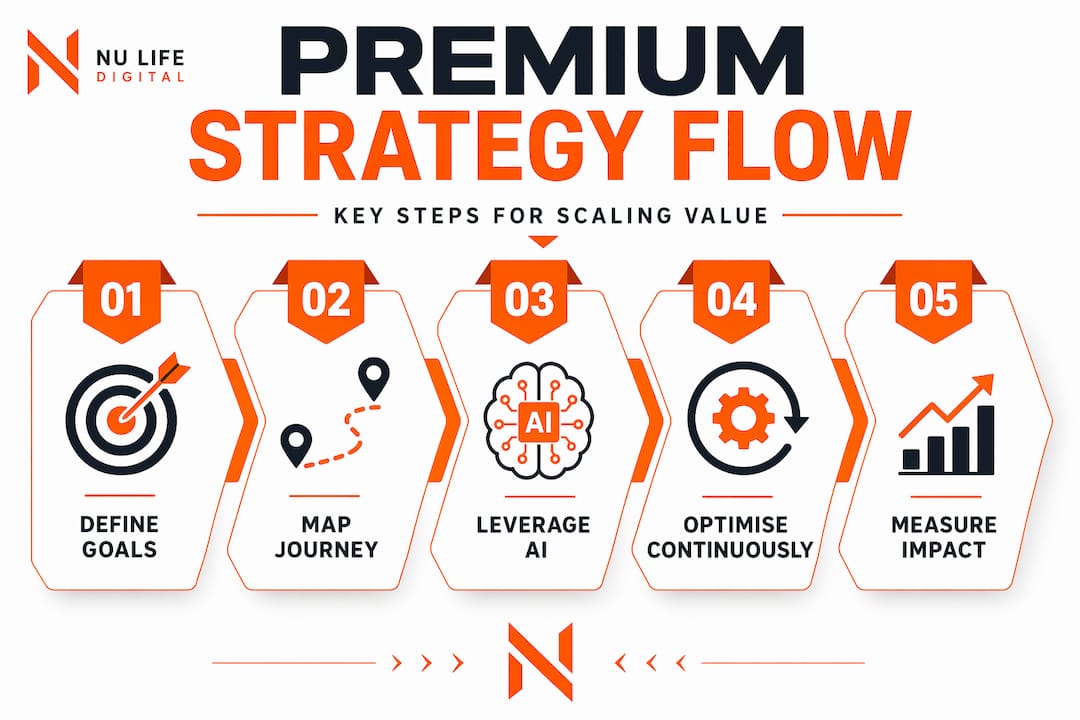
A premium strategy defines objectives, crafts messaging, orchestrates channels, instruments KPIs, and continually optimises. Think of it as a loop, not a straight line. Each stage feeds information back into the previous one, making the strategy sharper over time.
Here’s how that looks step by step:
- Define goals and success metrics. Before anything else, you need to know what you’re optimising for. Occupancy rate? Revenue per customer? Customer lifetime value? Specific, measurable goals prevent strategy drift.
- Identify and segment your audience. Who are your best customers? What do they value most? What are their friction points? Segmenting by behaviour, intent, and lifecycle stage lets you craft messaging that actually lands.
- Build your value proposition. This is not your tagline. It’s the precise reason a specific person should choose you over every alternative available to them. It must be distinct, credible, and directly relevant to each segment.
- Orchestrate your channels. Decide which platforms and touchpoints your audience uses at each stage of their journey, then design intentional transitions between them. Each channel has a role: awareness, nurturing, conversion, or retention.
- Instrument your KPIs. Set up tracking that connects channel activity to real business outcomes. Clicks are not results. Enquiries, bookings, and revenue are results.
- Test, measure, and iterate. Run structured experiments. Review data regularly. Feed what you learn back into your messaging, targeting, and channel mix.
| Stage | Primary objective | Key metric |
|---|---|---|
| Goals | Align activity to outcomes | Revenue, LTV, occupancy |
| Audience | Segment for relevance | Conversion rate by segment |
| Value proposition | Differentiate clearly | Engagement, enquiry quality |
| Channel orchestration | Deliver at every touchpoint | Multi-touch attribution |
| KPI tracking | Connect spend to revenue | ROI, CAC, ROAS |
| Iteration | Improve over time | Month-on-month performance |
Pro Tip: Document every stage of your strategy, not just the goals. Businesses that have a written, structured strategy are significantly more likely to hit their targets consistently than those who keep it in their heads or buried in a deck that never gets reviewed.
Businesses that treat their strategy workflow as a living document — reviewed quarterly and updated based on real performance data — outperform those who treat strategy as a one-time exercise. The framework is the scaffold. What you build on it changes as your market and customers evolve.
Applying premium strategy: Personalisation, AI, and customer journey excellence
Here is where things get genuinely exciting for ambitious businesses. The technology available today makes premium personalisation achievable for businesses that previously could only dream of it.

Premium customer guidance emphasises personalisation, proactive support, and seamless service across touchpoints. AI is the engine that makes this scalable. You don’t need a team of 50 to deliver personalised experiences to thousands of customers — you need the right systems.
Consider what this looks like across different sectors:
- Assisted living: An AI-powered admissions system can qualify enquiries, respond to families within minutes at any hour, and route high-intent leads directly to your admissions team. The family feels heard and supported from the very first interaction.
- E-commerce: Dynamic product recommendations, abandoned cart sequences triggered by specific browsing behaviour, and post-purchase journeys that drive repeat orders without lifting a finger.
- Luxury retreats: Personalised pre-arrival communications, tailored experience recommendations based on guest preferences, and automated follow-up that encourages rebooking at exactly the right moment.
The underlying principle is the same across all three: understand the customer’s context, anticipate their next need, and deliver the right message or experience before they have to ask.
Touchpoint orchestration is the discipline of making sure no stage of the customer journey is left to chance. Map every interaction from first awareness to post-purchase advocacy. Identify where customers drop off, where they get confused, and where the experience feels inconsistent. Then design intentional solutions for each gap.
Understanding marketing ROI at every touchpoint is essential — not just at the point of sale. When you know the value of a retained customer versus an acquired one, you make smarter investment decisions at every stage of your funnel.
Statistic: Businesses that implement AI-driven personalisation report significantly higher customer satisfaction scores and retention rates compared to those using generic, untargeted communication strategies.
Pro Tip: Start with one high-friction touchpoint in your customer journey, usually the first response after an enquiry or the post-purchase experience, and automate it intelligently. The ROI on that single improvement is often enough to fund your entire AI integration programme.
The goal is not to remove the human element. It’s to ensure that humans are focused where they add the most value, while AI handles the repetitive, time-sensitive, and data-intensive tasks that slow your team down and create gaps in the customer experience.
Pitfalls and keys to success in premium digital strategy
Every business that attempts to elevate its digital strategy will face the same set of temptations and traps. Knowing them in advance is the difference between building something that compounds and burning budget on tactics that don’t connect.
A practical digital strategy uses a documented, executable plan, tracks KPIs, and iterates via tests and learning. The businesses that fail to achieve this are usually caught in one of these patterns:
- Channel obsession over customer obsession. They invest heavily in a single platform — often the newest or most talked-about one — without asking whether their customers are there, or whether the channel fits the customer’s journey stage.
- Weak or absent measurement. They track activity (posts published, emails sent, ads running) rather than outcomes (revenue generated, enquiries converted, customers retained). Without outcome data, there’s no basis for informed decisions.
- Strategy that never gets reviewed. A strategy written in January and forgotten by March is not a strategy — it’s a document. Premium strategies are reviewed, challenged, and updated based on real performance data on a regular cadence.
- Treating optimisation as optional. The businesses that win are the ones that run structured experiments, learn what works, and systematically improve. This is not a creative exercise. It’s a disciplined, analytical process.
- Disconnected teams and tools. When your CRM doesn’t talk to your website, your email platform doesn’t sync with your ad data, and your sales team works from a different script to your marketing team, the customer experience suffers. Integration is not optional in a premium strategy.
“Strategy without measurement is just intention. Measurement without iteration is just data collection. Premium strategy is when all three work together in a continuous loop.”
The key best practices that counteract these pitfalls are equally straightforward:
- Build the full ecosystem first: website, traffic, lead handling, and retention.
- Tie every activity to a measurable business outcome before you launch it.
- Review performance monthly, not annually.
- Invest in conversion optimisation as an ongoing discipline, not a one-time fix.
- Train your team to understand what the strategy is trying to achieve, not just what they’re supposed to do.
Pro Tip: Create a simple monthly scorecard with five to eight KPIs that directly reflect your strategic goals. Review it in a one-hour meeting each month with the people responsible for each area. This single habit will surface problems early, celebrate what’s working, and keep the entire team aligned on outcomes rather than outputs.
Our perspective: Why most digital strategies fail to deliver premium results
After working with businesses across assisted living, e-commerce, and luxury experiences, the pattern is consistent. Most digital strategies don’t fail because of poor creativity or insufficient budget. They fail because of a fundamental misdiagnosis of the problem.
Businesses invest in channels first. They hire someone to run ads, or build a new website, or grow their social following. Each of those things in isolation can produce some results. But none of them, on their own, constitutes a strategy. They’re tactics wearing a strategy’s clothing.
The channel-first approach is particularly seductive because it produces visible activity. There are posts to point to. There are ads running. There are clicks in the dashboard. But activity is not results. And in high-value sectors — where a single client might be worth tens of thousands of pounds over their lifetime — settling for activity metrics is an extremely expensive mistake.
What genuinely separates businesses that scale from those that plateau is disciplined orchestration. Not just knowing which channels to use, but understanding why each channel exists in the customer journey, what it needs to deliver at that stage, and how it connects to every other touchpoint in the system.
We’ve seen this firsthand with clients who came to us having spent significant sums on paid advertising with little to show for it. The ads weren’t the problem. The landing pages, the follow-up systems, and the absence of a coherent customer journey were the problems. When we built the full ecosystem around the ads, the same spend produced dramatically different results.
The uncomfortable truth is that premium digital strategy requires patience and systems thinking — two things that don’t feel urgent when you’re focused on this month’s numbers. But the businesses that invest in building the right infrastructure for scale are the ones that look back in 18 months and wonder why they didn’t start sooner.
Agility matters too. The businesses that iterate quickly — testing messaging, refining targeting, improving conversion rates based on real data — compound their advantages over time. The ones that stick rigidly to a plan that isn’t working, because changing it feels like admitting failure, fall further behind with every passing quarter.
Take your business from good to premium with expert support
Building a premium digital strategy is not something most businesses can do effectively in-house, particularly when they’re simultaneously trying to deliver exceptional services to their clients. The detail, the systems thinking, and the technical execution all demand focused expertise.

At NU Life Digital, we build the full growth ecosystem that ambitious businesses need to scale properly. From high-converting web design engineered for enquiries and purchases, to AI-powered systems that handle lead nurturing and customer journeys automatically, to e-commerce growth strategies built for brands pushing to £50k and beyond per month. We work specifically with assisted living facilities, e-commerce brands, and luxury experience businesses because we know these sectors deeply and we know what it takes to win in them. If you’re ready to stop relying on tactics and start building a strategy that actually scales, we should talk.
Frequently asked questions
What distinguishes a premium digital strategy from a standard one?
A premium digital strategy focuses on delivering higher-value customer experiences and measurable ROI across the full customer lifecycle, rather than simply generating more leads or traffic volume.
How does AI enhance premium digital strategies?
AI allows businesses to deliver personalised and seamless journeys by automating decision-making, responding to customer behaviour in real time, and removing manual bottlenecks from the customer experience.
Why is continuous optimisation critical in premium digital strategy?
Because markets, customer behaviour, and competitive landscapes all shift constantly. Measuring and optimising on a regular cadence ensures your strategy stays effective and your ROI remains strong rather than deteriorating over time.
What are the main mistakes businesses make with premium digital strategies?
The most damaging mistakes are prioritising channel activity over customer experience and failing to track outcome-focused KPIs. A premium strategy must be documented, executable, and outcomes-oriented, not just a collection of active tactics.
How do I start creating a premium digital strategy?
Begin by defining specific business goals and your target audience segments, then build a distinct value proposition, map your customer journey across all touchpoints, and implement KPI tracking from day one. Defining objectives and audience before choosing channels is the critical first step most businesses skip.