
TL;DR:
- Scalable marketing grows results proportionally without increasing manual effort or headcount.
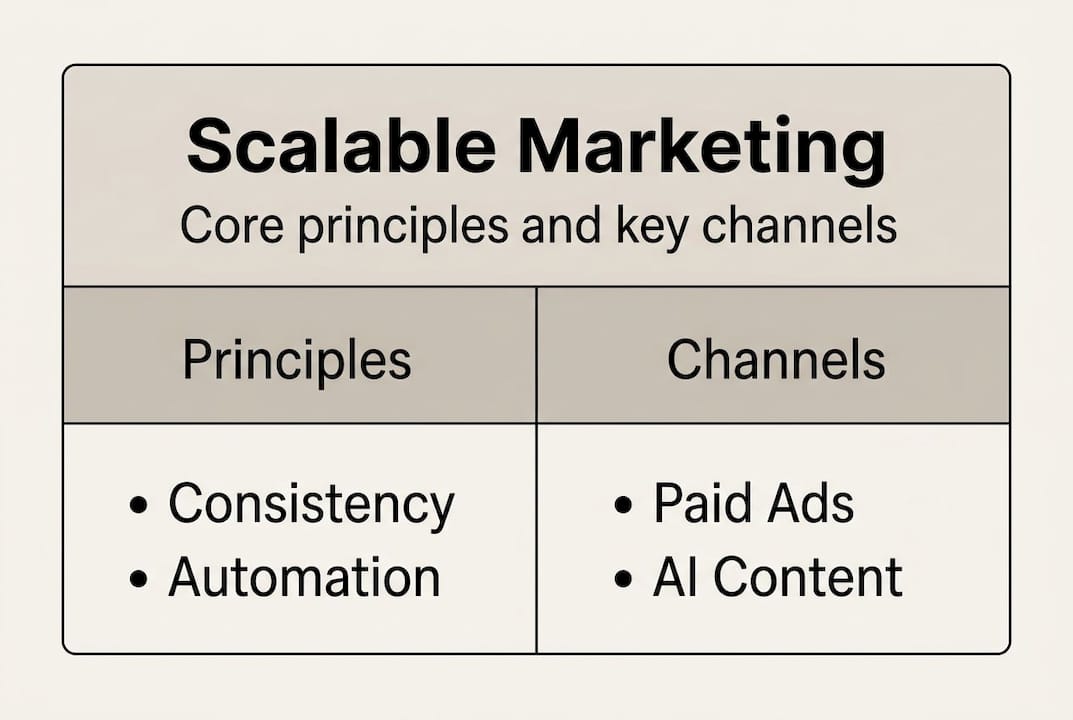
- Core principles include consistency, automation, data feedback, and long-term asset building.
- Effective channels are tailored to business type, focusing on efficiency and targeted growth strategies.
Many business owners hit a frustrating wall. They spend more on ads, hire more people, and push harder on social media, yet growth stalls. The problem is rarely effort. It is almost always the absence of a system that can grow without breaking. E-commerce brands using scalable tactics have recorded results like 21x ROAS and 41% revenue growth, not by working harder, but by building smarter. This article will define scalable marketing, break down its core principles, and give you a clear path to implementing it in your own business, whether you run a Shopify store or a niche service operation.
Table of Contents
- What is scalable marketing?
- Core principles of scalable marketing
- Techniques and channels for scaling your marketing
- How to implement scalable marketing strategies in your business
- Why scalable marketing isn’t just for ‘big brands’
- Accelerate your growth with expert scalable marketing solutions
- Frequently asked questions
Key Takeaways
| Point | Details |
|---|---|
| Scalable marketing defined | True scalability means marketing that grows results faster than costs by leveraging efficient tactics and technology. |
| Data drives growth | Tracking metrics like ROAS and CAC is essential to scaling up marketing impact sustainably. |
| Not just for big brands | Small businesses and niche players can achieve major growth with agile and scalable marketing strategies. |
| Start practical, optimise over time | Begin with repeatable tactics, automate as you grow, and continuously refine your strategy for best results. |
What is scalable marketing?
Scalable marketing is a strategic approach where your marketing output and results grow proportionally to your investment, without requiring a proportional increase in time, headcount, or manual effort. In plain terms: you build systems that do more as you feed them more, rather than constantly starting from scratch.
Traditional marketing often operates on a linear model. Spend £1,000 and get a certain number of leads. Spend £10,000 and hope for ten times the leads, but also take on ten times the workload. Scalable marketing breaks that relationship. The infrastructure you build, your automations, your data models, your conversion funnels, keeps working as you scale spend or audience size.
This matters enormously for ambitious businesses. Understanding scalable marketing basics is the first step towards building a growth engine rather than a growth treadmill. And staying across digital marketing trends ensures your systems remain competitive as the landscape shifts.
Here is a quick comparison to make the distinction concrete:
| Traditional marketing | Scalable marketing |
|---|---|
| Manual campaign management | Automated workflows and bidding |
| Flat or declining ROAS at scale | Improving ROAS as data accumulates |
| Growth requires more headcount | Growth driven by smarter systems |
| Reactive to market changes | Proactive, data-led adjustments |
| Short-term campaign focus | Long-term compounding returns |
The evidence backs this up. 21x ROAS and 41% revenue growth are not outliers reserved for brands with enormous budgets. They are the result of building the right foundations.
Scalable marketing is especially vital when you are:
- Moving from £10k to £100k monthly revenue targets
- Entering new markets or launching new product lines
- Looking to reduce cost per acquisition while growing volume
- Building a business that can operate without constant founder involvement
Core principles of scalable marketing
Once you understand what scalable marketing is, the next step is grasping the principles that make it work. These are not tactics. They are the structural rules that determine whether your marketing can grow with you.
Consistency across every touchpoint. Scalable marketing demands that your brand, messaging, and customer experience remain coherent whether you are reaching 100 people or 100,000. Inconsistency creates friction, and friction kills conversion at scale.

Data-driven decision making. Gut instinct has its place, but it cannot scale. Every campaign, every channel, and every audience segment needs clear KPIs attached to it. You need to know what is working before you invest more in it. Conversion workflows built on measurable actions give you the feedback loops required to optimise intelligently.
Here is a framework summary to guide your thinking:
| Principle | What it means in practice | Why it matters |
|---|---|---|
| Repeatability | Campaigns can be replicated without reinvention | Saves time and reduces error |
| Automation | Routine tasks handled by systems, not people | Frees resource for strategy |
| Data feedback | Every action generates measurable insight | Enables constant improvement |
| Channel fit | Marketing channels match your audience and model | Maximises ROI per pound spent |
| Compounding assets | Content and SEO build value over time | Long-term return on investment |
Case studies confirm that AI and automation have delivered a 340% ROAS lift alongside meaningfully lower customer acquisition costs. That is the power of principle two in action.
Pro Tip: Before you invest in automation tools, spend 30 days tracking your key metrics manually. You will spot patterns and inefficiencies that no software can identify for you, and you will know exactly what to automate first.
The mindset shift here is significant. Scalable marketing requires you to think like an engineer as much as a marketer. Build processes that can be handed off, replicated, and improved. Explore paid advertising strategies that are built for performance at scale, not just short-term wins.
- Define your core KPIs before launching any campaign
- Document every successful campaign so it can be repeated
- Invest in tools that generate data, not just activity
- Review performance weekly and adjust based on evidence
- Build automation into your workflow from the start, not as an afterthought
Techniques and channels for scaling your marketing
With the right frameworks in place, the next question is which specific techniques and channels actually support scalability. Not all channels are created equal when it comes to growth.
Paid advertising remains one of the most scalable channels available, particularly when campaigns are structured with clear audience segmentation and automated bidding strategies. Paid advertising and growth go hand in hand when campaigns are built to optimise themselves over time rather than requiring constant manual intervention.
AI-driven content and CRO are rapidly becoming non-negotiable. Connected TV (CTV) and AI-powered conversion rate optimisation have delivered 41% revenue growth and a 340% ROAS lift respectively in documented e-commerce cases. These are not experimental tactics. They are proven levers.
Email automation is arguably the most underrated scalable channel. A well-built email sequence works around the clock, nurturing leads and recovering abandoned carts without any additional spend. Pair it with strong content marketing strategies and you create a compounding asset that grows in value over time.
Here are the channels that scale most effectively, matched to business type:
- E-commerce brands: Paid social, Google Shopping, email automation, AI CRO, CTV
- Niche B2C (retreats, experiences): Targeted paid search, retargeting, content-led SEO
- Service businesses and B2B: LinkedIn ads, email nurture sequences, conversion-focused landing pages
- Local and niche operators: Hyper-targeted Google Ads, local SEO, review generation systems
Pro Tip: Resist the temptation to be everywhere at once. Identify the one or two channels where your audience is most active and where your data shows the strongest ROI. Scale those aggressively before diversifying.
The key insight here is that scalability is not about volume. It is about efficiency at volume. The best channels for you are the ones where your cost per acquisition drops, or at least holds steady, as you spend more.
How to implement scalable marketing strategies in your business
Knowing what scalable marketing looks like is one thing. Actually building it into your business is another. Here is a practical sequence that works for growing businesses at various stages.
- Audit your current marketing. Identify what is generating measurable returns and what is consuming budget without clear output. Be ruthless.
- Define your growth targets. Scalable marketing needs a destination. Set specific revenue, ROAS, and CAC targets for the next 6 and 12 months.
- Test before you scale. Run small, controlled experiments on new channels or creative approaches. Prove the model at low spend before committing significant budget.
- Automate what works. Once a campaign or process is proven, systematise it. Automation is how you remove the ceiling on growth.
- Optimise continuously. Scalable marketing is never finished. Build regular review cycles into your operations.
Businesses that followed structured, scalable approaches achieved 70% higher ROAS and 48% lower CAC compared to those relying on ad hoc campaign management. The difference is process.
“The brands that scale fastest are not the ones with the biggest budgets. They are the ones with the clearest systems and the discipline to follow the data.”
Common mistakes that limit scalability include:
- Scaling spend before proving the model at small budgets
- Ignoring landing page and website conversion quality
- Treating every channel as a standalone effort rather than part of a system
- Failing to document campaigns, making replication impossible
- Measuring vanity metrics (clicks, impressions) instead of revenue-linked KPIs
For mid-sized businesses, working with digital agencies that specialise in scalable systems can dramatically shorten the learning curve. Expect meaningful results within three to six months of disciplined implementation, with compounding returns building over the following year.
Why scalable marketing isn’t just for ‘big brands’
Here is the myth that holds back more ambitious businesses than almost anything else: the idea that scalable marketing requires a large budget, a big team, or enterprise-level technology. It does not.
In fact, smaller and mid-sized businesses often have a structural advantage. They can move faster, test more freely, and pivot without layers of approval. Large brands are frequently slowed down by legacy systems and internal politics. You are not.
Even smaller e-commerce businesses have recorded up to 41% revenue growth by applying scalable marketing principles with lean teams and focused budgets. The tools that once required enterprise contracts are now accessible to any business willing to invest in the right infrastructure.
Starting lean is not a disadvantage. It is a forcing function. When you cannot afford to waste budget, you build tighter systems, track more carefully, and make smarter decisions. Those habits compound. Businesses that build loyalty through digital tools from an early stage find that their cost to retain and grow customers drops significantly as they scale. The founders who build scalable systems early are the ones who stop trading time for growth, and start building something that works without them.
Accelerate your growth with expert scalable marketing solutions
Scalable marketing works for businesses of every size, but getting there faster requires the right expertise and infrastructure behind you.

At NU Life Digital, we build growth engines for ambitious businesses. Whether you need e-commerce solutions that turn traffic into consistent revenue, AI automation services that remove manual bottlenecks from your marketing, or modern web design engineered to convert, we bring the strategy, systems, and execution together in one place. If you are ready to stop guessing and start scaling with a clear plan behind you, we would love to talk.
Frequently asked questions
What are the most important metrics for scalable marketing?
Return on ad spend (ROAS), customer acquisition cost (CAC), and conversion rate are the primary metrics for tracking scalability. E-commerce successes have been measured by outcomes including 21x ROAS and 48% lower CAC, making these the benchmarks to aim for.
Can scalable marketing work for service businesses or just e-commerce?
Scalable marketing applies equally to service businesses and e-commerce brands, since core strategies like automation, CRO, and paid media are adaptable to virtually any business model or audience.
How quickly can you see results from implementing scalable marketing?
Initial results can appear within a few months, though sustainable growth requires ongoing optimisation. Brands that implemented scalable approaches saw measurable ROAS lifts and lower CAC after consistent, structured implementation over time.
Is automation necessary for effective scalable marketing?
Automation is strongly recommended but not a prerequisite from day one. Scalable marketing begins with repeatable, data-driven processes, and AI and automation can then be layered in to accelerate results, as evidenced by a 340% ROAS lift in documented case studies.