
TL;DR:
- Effective audience segmentation prioritizes reachability and measurability over broad demographics, enabling better ad performance. Combining methods like behavioral, demographic, psychographic, and needs-based approaches creates more actionable segments that drive targeted messaging and higher returns. Consistent activation, measurement, and refinement of segments are essential to translating audience insight into measurable campaign success.
Most marketing managers assume the solution to poor ad performance is more budget. In reality, the problem is almost always the audience. Targeting too broadly inflates your cost per acquisition, wastes spend on people who will never convert, and dilutes the message to the point where nobody feels spoken to. Effective audience segmentation flips this around entirely. It lets you spend less whilst reaching fewer but far more relevant people, driving stronger returns across every campaign. This guide covers practical, actionable segmentation frameworks tailored specifically to e-commerce and assisted living marketing teams.
Table of Contents
- What is segmentation in advertising and why does it matter?
- Types of segmentation methods: Demographic, behavioural, psychographic, and hybrid approaches
- Turning audience segments into high-impact ad strategies
- Segmentation for remarketing and omnichannel campaigns
- Avoiding segmentation traps: Precision, measurement, and vertical nuances
- Why most segmentation strategies underperform: The missing activation step
- Put segmentation to work with proven ad strategies
- Frequently asked questions
Key Takeaways
| Point | Details |
|---|---|
| Actionable segments drive ROI | Only segments that are practical to target and measure yield significant returns on ad spend. |
| Hybrid methods prevent blind spots | Combining demographic, behavioural, and psychographic insights ensures complete audience understanding. |
| Activation is the missing link | Segments must lead directly to targeted campaigns, not remain as marketing theory or reports. |
| Channel mix matters for every sector | E-commerce and assisted living require unique segmentation tactics matched to their buying cycle and touchpoints. |
| Regular review keeps segments relevant | Reassess your segments often to adapt to changing performance and audience behaviour. |
What is segmentation in advertising and why does it matter?
Segmentation is not simply choosing an age range or a location in your ad platform and calling it targeting. True segmentation means dividing your potential audience into distinct groups that are meaningfully different from each other and, crucially, different in ways that should change what you say to them and how you say it.
Understanding why ad targeting matters at a structural level is the first step. When your targeting is precise, your creative resonates, your landing pages convert, and your budget goes further. When it is not, you are essentially running a billboard campaign with paid social price tags.
According to performance marketing research, actionable segmentation must pass three rigorous tests: a segment must be identifiable (defined with enough consistency to build reliable audience lists), reachable (activatable across the channels you actually use), and evaluable (measurable economically so you can judge its value against alternatives). Most teams get the first test right and completely ignore the other two.
Here is what that looks like in practice. An e-commerce brand selling premium skincare might define “women aged 28 to 45 interested in beauty” as a segment. That is identifiable. But is it reachable in a way that is meaningfully different from your general audience? Can you measure that segment’s incremental revenue contribution vs your baseline? Probably not without more structure.
A segment that cannot be activated and measured is just a demographic description. It becomes a strategy only when you can reach it, message to it specifically, and track the outcome.
Key qualities every segment needs before you commit budget:
- Identifiable: Defined by consistent, repeatable criteria across your tools and channels
- Reachable: Targetable through at least one paid channel at scale
- Evaluable: Measurable via a KPI that connects to real business value
- Differentiated: Genuinely different from your other segments in behaviour, needs, or intent
Pro Tip: Before building your next campaign, run each proposed segment through these three questions. If you cannot reach it or measure it, refine or drop it before you spend a penny.
Start with identifying your target audience correctly, and the rest of your segmentation strategy becomes far more manageable.
Types of segmentation methods: Demographic, behavioural, psychographic, and hybrid approaches
With the foundation set, it is crucial to understand the main segmentation approaches at your disposal and how blending them can multiply your results.
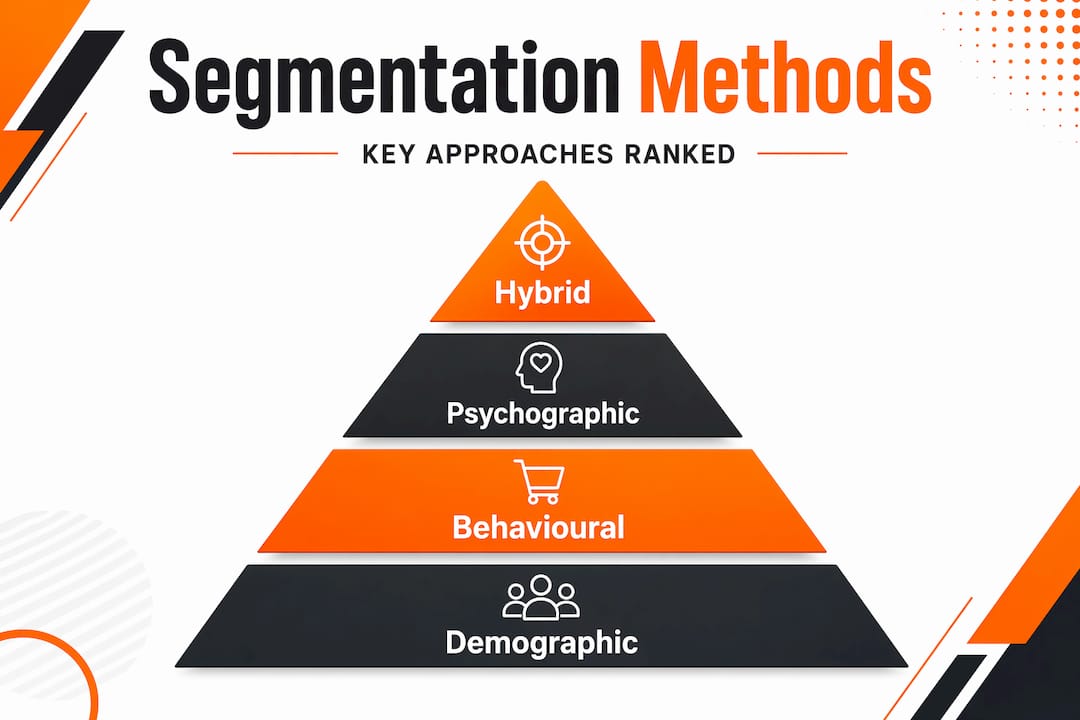
There are four primary segmentation methods used in digital advertising. Each has strengths and weaknesses. None of them, used alone, is sufficient for competitive markets in 2026.
Effective data-driven segmentation requires you to understand what each method reveals and what it misses.
1. Demographic segmentation uses age, gender, income level, location, and household composition. It is the easiest to implement but the shallowest in insight. Two 45-year-old women with the same income might have completely different reasons for considering assisted living for a parent, or for buying a skincare product.
2. Behavioural segmentation focuses on what people have actually done: pages visited, products viewed, forms started but not submitted, purchases made, or time spent on specific content. This is the most powerful method for remarketing because it is grounded in demonstrated intent rather than assumptions.
3. Psychographic segmentation captures values, lifestyle, attitudes, and motivations. It answers why people buy, not just who they are. For assisted living, psychographics might separate “proactive planners” from “crisis responders,” two groups with very different messaging needs.
4. Needs-based and persona-driven segmentation takes a hybrid approach, combining what people need functionally with who they are. According to TheMarketingJuice, segmentation strategy often involves mixing and matching segment types rather than relying on a single dimension, and that combining approaches reduces the risk of false precision that comes from over-relying on any one method.
Explore audience needs discovery to understand how to surface the underlying motivations driving your audience decisions.
| Method | Definition | E-commerce example | Assisted living example | Best-use case |
|---|---|---|---|---|
| Demographic | Age, gender, income, location | Women aged 30 to 50 in London | Adult children aged 45 to 65 caring for a parent | Broad awareness campaigns |
| Behavioural | Actions taken on site or app | Viewed product 3 times, no purchase | Visited pricing page, requested no contact | Remarketing and re-engagement |
| Psychographic | Values, lifestyle, motivations | Eco-conscious shoppers prioritising sustainability | Families seeking reassurance and safety | Message personalisation |
| Needs-based | Functional requirements and pain points | Shoppers with sensitive skin seeking fragrance-free options | Families needing memory care support urgently | High-intent conversion campaigns |
| Hybrid | Combination of two or more methods | Behavioural plus demographic for cart abandoners | Psychographic plus behavioural for long-lead nurturing | Multi-stage funnels |
Pro Tip: For the most actionable and accurate segments, combine at least two types. Behaviour tells you what someone did. Demographics or psychographics help explain why, and that combination lets you craft messages that actually land.
Turning audience segments into high-impact ad strategies
Once you recognise the segmentation methods, the next challenge and opportunity is putting them to work throughout your advertising strategy.

Defining segments is the research phase. Activating them is where the real work begins. Many campaigns fail not because the segments were wrong, but because nobody translated them into concrete ad plans with specific messages, offers, and success metrics for each audience group.
Analytics for business growth plays a critical role here. Without measurement infrastructure in place before you launch, you cannot evaluate whether your segments are performing differently, which is the entire point.
The activation process follows a clear sequence:
- Define the segment using your combined methodology (demographic plus behavioural, for example)
- Test reachability by checking audience size estimates in your chosen platforms
- Create segment-specific creative with tailored messaging, imagery, and offers
- Set clear KPIs for each segment before spend begins
- Activate across channels with consistent audience definitions
- Measure and refine using your data insights at regular intervals
As Umbrex’s performance marketing research confirms, actionable segmentation requires both a planning function and an activation framework. You identify, reach, and measure, then tailor targeting, messaging, and offers by segment. Skipping any of those steps reduces your segmentation from a revenue lever to a spreadsheet exercise.
Here is a practical mapping of how this looks in action:
| Segment | Channel | Message | Offer | KPI |
|---|---|---|---|---|
| E-commerce: Abandoned cart, high-value items | Meta remarketing | “Still thinking it over? Here is 10% off.” | Discount code, 48-hour expiry | Conversion rate, ROAS |
| E-commerce: Loyal buyers, 3+ purchases | Email + Google | “You know us. Here is early access.” | Exclusive product preview | Repeat purchase rate |
| Assisted living: Adult children, research stage | Google Search + YouTube | “Understanding your options takes time. Here is a guide.” | Free care assessment download | Lead quality score |
| Assisted living: Urgent enquirers, visited pricing | Facebook retargeting + phone | “Speak to an adviser today.” | Direct call CTA | Call conversions, booked tours |
Research on using data for actionable insights consistently shows that organisations matching message to segment stage see dramatically improved conversion rates compared to those running a single message to all audiences.
Campaigns built around segment-specific activation plans typically outperform generic campaigns by a significant margin. The difference is not the budget, it is the relevance.
Segmentation for remarketing and omnichannel campaigns
Segmentation is not just for first-touch campaigns. It drives powerful remarketing and enables true omnichannel personalisation that keeps your brand relevant across every stage of the customer journey.
Remarketing is arguably the highest-value application of audience segmentation. Google Ads audience segments are commonly used for remarketing, using audiences defined by website or app actions, and integrating platforms like Google Analytics to build segments based on rules you define. Someone who viewed three product pages in a session is a very different prospect to someone who bounced after three seconds on your homepage.
For omnichannel campaigns, consistent audience definitions across every channel are essential. If your segment is defined differently in Google than in Meta, your reporting becomes meaningless and your spend overlaps in ways you cannot track.
For assisted living specifically, the omnichannel challenge is significant. Decision cycles can run for months. The eventual conversion rarely happens online. Segmentation here must support longer nurture sequences, trust-building content, and offline measurement like call tracking and booked facility tours.
Workflow steps for setting up effective segmented remarketing:
- Install and verify your tracking across all relevant pages before building any audience lists
- Define your segment rules based on specific behaviours (pages visited, time on site, actions taken)
- Set minimum audience sizes to ensure your segments meet platform thresholds for delivery
- Create tailored creative for each segment that acknowledges what the user has already seen or done
- Integrate your CRM so offline conversions (calls, enquiries, tours) feed back into your digital segments
- Use survey-created segments to validate what your data suggests about audience motivations
- Sync definitions across platforms using tools like UTM parameters, pixel events, and audience exports
“A unified audience definition across every platform is not a technical nicety. It is the foundation of any measurement strategy that actually tells you what is working.”
For ad targeting for growth to deliver consistently, your remarketing segments must be refreshed regularly and reviewed against performance data. Stale segments built on outdated behaviour signals waste budget on audiences who have already converted or moved on entirely. Your ROI advertising strategies need live, accurate audience data to perform.
Avoiding segmentation traps: Precision, measurement, and vertical nuances
To get the most out of segmentation, it is essential to be aware of and intentionally avoid some frequent pitfalls, and to adapt your approach for the specific demands of your vertical.
The false precision trap is the most common. Marketing teams spend weeks building elaborate segment taxonomies with dozens of sub-groups, then discover none of them are large enough to generate statistically reliable data. The result is fragmented reporting, underpowered ad sets, and no clear conclusions. Fewer, broader segments with strong hypotheses almost always outperform over-engineered ones.
Steps to avoid the most common segmentation errors:
- Start with three to five core segments before adding complexity
- Validate each segment size against platform minimum thresholds before activating
- Run a measurement framework check to confirm you can track meaningful outcomes for each segment
- Compare segment performance quarterly and eliminate those that consistently underperform
- Document your segment definitions so they remain consistent across team members and campaigns
Assisted living segmentation demands particular care. Because conversions happen offline and the decision cycle is long, segmentation must incorporate call tracking and a channel mix that supports earlier trust-building, not just last-click measurable actions. Attributing a facility tour booking to the last ad someone clicked fundamentally misrepresents how that family made their decision.
For e-commerce, the opposite challenge exists. Behavioural segments can be refreshed rapidly, but over-relying on short-term behavioural signals (one product page view, for example) creates noisy audiences that drain budget without delivering meaningful lift. Anchor behavioural segments to intent signals with more weight: multiple product views, cart additions, time-on-page above average, or return visits within a defined window.
Pro Tip: Review your segments every quarter. Any segment that has not generated enough volume to produce statistical confidence, or has not contributed meaningfully to your campaign goals, should be simplified or retired. Complexity for its own sake is the enemy of performance.
Explore a step-by-step ad segmentation approach to build this discipline into your campaign planning process from the start.
Why most segmentation strategies underperform: The missing activation step
Here is the uncomfortable reality we see consistently across both e-commerce and assisted living clients. The segmentation itself is usually not the problem. Most marketing teams can describe their audience reasonably well. What they cannot do is translate that description into a live, channel-specific activation plan with distinct messaging, tailored creative, and segment-level measurement.
Segments get built in a strategy deck and never make it into the actual ad account. Or they do make it into the account, but the creative is identical across all segments, defeating the entire purpose. You cannot run the same video ad to a cold audience who has never heard of you and a warm retargeting audience who has already visited your pricing page three times. Those two groups need completely different conversations.
The organisations seeing outsised returns from segmentation are not the ones with the most sophisticated audience models. They are the ones with the discipline to actually execute against those models, campaign after campaign. They test one segment hypothesis at a time. They measure incrementally. They retire what does not work and scale what does.
For high-ROI segmentation strategies to deliver in practice, the bridge between the planning document and the live campaign has to be intentional and structured. That activation discipline is the real differentiator between teams who find segmentation useful in theory and those who use it to genuinely move revenue.
Put segmentation to work with proven ad strategies
Sharper segmentation without the right infrastructure behind it only gets you so far. At NU Life Digital, we specialise in building the full activation layer that turns audience insight into campaign performance, whether you are scaling an e-commerce brand or filling assisted living enquiry pipelines.

We combine advanced audience segmentation with tailored creative strategy, conversion-focused landing pages, and measurement frameworks that track what actually matters. Our work spans both e-commerce brands targeting £50k to £100k+ monthly revenue and assisted living facilities needing consistent, high-quality enquiries. If you want campaigns that do more than generate clicks, explore our ad strategies for ROI or see how our conversion-ready web design turns traffic into tangible revenue. Book a consultation and let us map your segmentation strategy directly to your growth goals.
Frequently asked questions
What makes a segment actionable in advertising?
An actionable segment is identifiable with consistent criteria, reachable through your actual ad channels, and evaluable so you can measure its economic value compared to alternatives.
How does segmentation improve remarketing campaigns?
Segmentation enables precise audience lists for remarketing by targeting users based on defined actions. Google Ads remarketing uses segments built from website and app behaviours, making follow-up ads far more relevant and cost-efficient than broad retargeting.
Is there a “best” segmentation method for all industries?
No. Combining segment types such as behavioural with demographic or needs-based approaches consistently outperforms any single method, because different methods reveal different aspects of your audience.
Why is segmentation different for assisted living compared to e-commerce?
Assisted living involves longer decision cycles and offline conversions, so segmentation must include call tracking and trust-first nurturing strategies. E-commerce typically benefits from faster, behaviour-driven segments tied to shorter purchase cycles.
Can segments change over time and how often should they be reviewed?
Yes, segment performance shifts as audience behaviour, market conditions, and platform algorithms evolve. Reviewing and refining your segments quarterly ensures they remain accurate, large enough to be statistically meaningful, and aligned with your current campaign goals.