
TL;DR:
- Most website traffic is not the issue; instead, poor page design hinders conversions.
- To increase engagement, focus on clear value, trust signals, and well-placed calls to action tailored to your sector.
You’ve invested in traffic. Your analytics show visitors arriving daily, yet your enquiry inbox stays quiet and your checkout sits idle. This gap between visitors and conversions is one of the most common frustrations we see from assisted living operators and e-commerce founders alike. The good news is that it is almost never a traffic problem. It is a page problem. This article walks you through a structured, research-backed process for building pages that turn browsers into buyers and curious families into genuine enquiries, creating a foundation for sustainable, measurable growth.
Table of Contents
- Understanding what drives conversions online
- Preparing your site: Design, content, and essential tools
- Step-by-step: Building a high converting page
- Testing and refining: Maximising your conversion rates
- What most conversion guides miss: Lessons from assisted living and e-commerce
- Take your next step to higher conversions
- Frequently asked questions
Key Takeaways
| Point | Details |
|---|---|
| Conversion drivers matter | Focusing on motivation, value, and trust is the foundation of high converting pages. |
| Preparation is key | Effective design, tailored content, and the right tools set up pages for success. |
| Build with purpose | Follow a step-by-step approach that matches your industry’s requirements for best results. |
| Test and refine | Continuous A/B testing and data-led optimisation maximises conversion rates over time. |
| Expert insight wins | Sector-specific refinements outperform generic advice, especially in assisted living and e-commerce. |
Understanding what drives conversions online
Most business owners treat their website like a digital brochure. It looks presentable, it holds information, and it sits there waiting for something to happen. That mindset is the first thing to change. A high converting page is not a passive document; it is an active sales system designed around one primary goal.
At the heart of every conversion is a simple equation: the visitor must clearly understand the value on offer, trust the organisation presenting it, and feel prompted by a relevant, well-timed call to action (CTA). Remove any one of those three and the conversion stalls. Your website conversion for business growth hinges on all three working together.
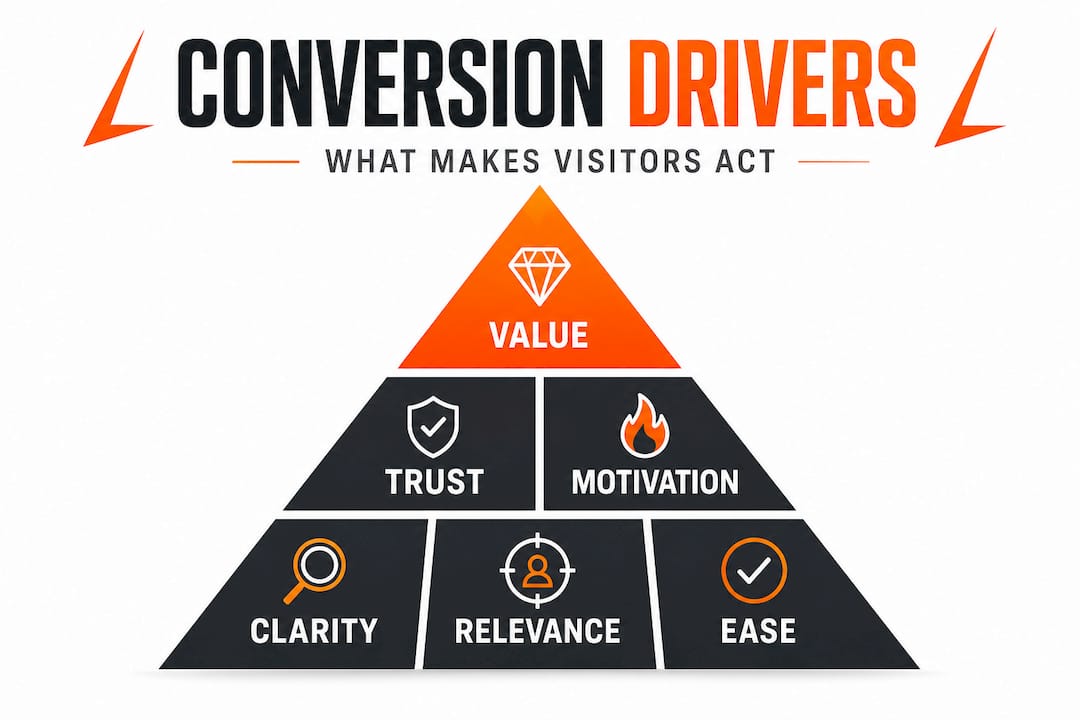
The decision triggers are quite different depending on your sector, and understanding this distinction is crucial before you build a single page.
| Factor | Assisted living | E-commerce |
|---|---|---|
| Primary emotion | Trust, safety, family reassurance | Desire, value, urgency |
| Decision timeline | Weeks to months | Minutes to days |
| Key proof elements | Staff credentials, CQC ratings, testimonials | Reviews, product images, returns policy |
| CTA style | Soft enquiry, call booking, virtual tour | Add to basket, limited stock, buy now |
| Key trust signal | Care philosophy, regulatory compliance | Secure checkout badges, brand reputation |
For assisted living operators, a family researching care options is emotionally vulnerable and time-pressed. Every page element must signal empathy and competence simultaneously. For e-commerce brands, friction is the enemy. Shoppers decide fast, and anything that slows the path to purchase bleeds revenue.
Video is one of the most underused tools in both sectors. Video CTAs convert at 16% on average, particularly when placed at the end of longer content and written with action-oriented language. A virtual tour of a care facility with a soft “Book your visit” CTA at the close, or a product demonstration video ending with “Add to bag,” will consistently outperform static pages.
The single biggest mindset shift here is moving from measuring traffic to measuring conversions. Pageviews flatter. Conversion rates tell the truth. Your landing page optimisation guide can help you reframe your entire measurement framework around what actually matters.
Key conversion drivers to prioritise at this stage:
- A single, unambiguous value proposition above the fold
- Visual trust signals relevant to your specific audience
- Navigation that does not pull visitors away from the primary goal
- Mobile responsiveness as a baseline, not a bonus
- Page load speed under three seconds
Preparing your site: Design, content, and essential tools
Knowing what drives conversions is half the battle. The other half is ensuring your site infrastructure can support a conversion-first approach before you write a single word of copy or choose a single colour.

Start with design fundamentals. Responsive layouts are non-negotiable; the majority of care-related searches and a significant proportion of product browsing happen on mobile devices. Readable fonts, sufficient colour contrast, and logical navigation hierarchies reduce cognitive load and keep visitors on the page longer. A visitor who cannot find what they need within seconds will leave.
Content requirements differ sharply between sectors. For assisted living, benefit-driven copy must address the unspoken fears of adult children searching for a parent’s care: “Will they be safe? Will they be treated with dignity? Can we afford it?” Every headline, subheading, and paragraph should answer one of these questions directly. For e-commerce, copy must focus on product outcomes rather than features. “Arrives in two days, no fuss returns” speaks louder than a list of technical specifications.
| Tool category | Purpose | Example use case |
|---|---|---|
| Landing page builder | Rapid page creation and testing | Building sector-specific lead capture pages |
| Heatmap software | Visualise where visitors click and scroll | Identifying ignored CTAs or confusing layouts |
| Analytics platform | Track conversion funnels and drop-off points | Spotting the exact step where users abandon |
| A/B testing tool | Compare page variations systematically | Testing two headline versions on a care enquiry page |
| CRM integration | Capture and nurture leads automatically | Routing care enquiries to admissions teams instantly |
Trust signals deserve special attention. For assisted living, these include regulatory compliance notices, staff qualifications, named care coordinators with photos, and genuine family testimonials with full names. Generic five-star ratings without context carry very little weight with anxious families. For e-commerce, trust signals include verified reviews, clear returns policies, security badges at checkout, and social proof such as “Over 12,000 customers served.”
Pro Tip: If you are producing longer explainer videos or facility tour content, use the final ten seconds for your CTA. Video CTAs perform best when ungated for maximum lead volume, or gated when your primary goal is attracting highly qualified enquiries rather than raw numbers.
Use the website checklist for high conversions to audit your current site against these criteria before you proceed. Skipping this step means building on a weak foundation, and no amount of clever copywriting will fix structural design problems.
Step-by-step: Building a high converting page
With your foundation in place, here is how to build a page that genuinely performs. This process works for both an assisted living enquiry page and an e-commerce product or landing page. Adjust the sector-specific details at each step.
-
Define a single goal. Every high converting page has one primary action you want the visitor to take. For assisted living, this might be booking a tour. For e-commerce, it is completing a purchase. Remove or relocate anything that does not serve that goal.
-
Write your value proposition first. Before designing anything, write one sentence that explains who the page is for, what it offers, and why it matters. This sentence becomes your headline and anchors every subsequent design decision.
-
Structure content in order of visitor priority. Lead with the benefit, follow with the proof, end with the CTA. Visitors scan pages in an F-pattern. The most critical information belongs at the top left and in the first paragraph. Apply these conversion optimisation tips when structuring each section.
-
Design your CTA for maximum clarity. Button copy should describe the outcome, not the action. “Get your free care guide” converts better than “Submit.” “See today’s deals” outperforms “Click here.” For assisted living, soften the tone: “Talk to our team” feels far less pressured than “Book now.”
-
Add sector-specific social proof. For assisted living, place a family testimonial immediately below the fold, ideally with a photograph and the reviewer’s relationship to the resident. For e-commerce, use verified review counts near the add-to-basket button and star ratings on product images.
-
Introduce urgency where it is genuine. E-commerce can legitimately use stock levels, limited-time pricing, and countdown timers for real promotions. Assisted living pages should avoid manufactured urgency; instead, use factual scarcity such as current bed availability or waiting list information.
-
Build in compliance and accessibility. For assisted living facilities operating under CQC or equivalent frameworks, relevant regulatory statements must appear. For e-commerce, GDPR-compliant data capture forms are essential. These are not optional extras; they are trust-building necessities.
“The page that converts is not the prettiest one. It is the one that most clearly answers the visitor’s question and removes every obstacle between them and the next step.”
Pro Tip: Action-oriented, ungated CTAs will capture the highest volume of leads. If your admissions team needs only serious enquiries, gate your downloadable content such as a care guide or pricing brochure. For e-commerce, keep the path to purchase completely friction-free. Review this conversion workflow for growth to map your own lead journey from first click to conversion.
Testing and refining: Maximising your conversion rates
Building the page is step one. The real gains come from what you do after it goes live. Most businesses launch a page, forget about it, and wonder why results plateau after the initial spike. Systematic testing is what separates businesses that grow consistently from those that rely on luck.
Start with your core key performance indicators. Conversion rate is the headline metric, calculated as conversions divided by total sessions multiplied by 100. But micro-conversions matter equally: scroll depth, time on page, video play rate, CTA click-through rate, and form completion rate. Each tells a specific story about where your page is winning or losing attention.
A/B testing involves sending equal traffic to two versions of the same page, changing one element at a time. This is ideal for single-variable decisions: which headline performs better, which CTA colour drives more clicks, which hero image generates more enquiries. Multivariate testing tests multiple changes simultaneously and requires significantly higher traffic volumes to reach statistical significance. For most assisted living operators and growing e-commerce brands, A/B testing is the right starting point.
| Optimisation method | Best for | Traffic required | Time to results |
|---|---|---|---|
| Manual A/B testing | Single element changes | 1,000+ sessions per variant | 2 to 4 weeks |
| Automated multivariate | Complex page layouts | 5,000+ sessions per variant | 4 to 8 weeks |
| Heatmap analysis | Understanding user behaviour | Any traffic level | Ongoing |
| Session recording | Identifying friction points | Any traffic level | Immediate insight |
| Funnel analytics | Pinpointing drop-off stages | Any traffic level | Weekly review |
Common quick wins that frequently move conversion rates:
- Simplifying form fields. Remove every optional field; each additional field reduces completion rates.
- Moving the primary CTA above the fold on mobile
- Replacing generic stock photography with real staff or product images
- Adding a visible phone number in the header for assisted living pages specifically
- Improving page speed by compressing images and reducing script load times
- Clarifying the CTA button text to describe the outcome
Review your proven conversion tactics library regularly, as sector-specific improvements often outperform generic recommendations. These conversion optimisation strategies give you a systematic framework for deciding which tests to run next and in what order.
Warning signs that a page needs urgent attention include bounce rates above 70% on mobile, average time on page below 30 seconds, and CTA click rates below 1%. When you see those numbers, stop sending paid traffic to that page immediately and diagnose before spending another penny.
What most conversion guides miss: Lessons from assisted living and e-commerce
Here is something that frustrates us about the conversion rate optimisation industry. Most of the advice out there is built on data from software companies and lead generation funnels. Apply it wholesale to an assisted living facility or a niche e-commerce brand and you will get mediocre results at best.
For assisted living, the single biggest conversion lever is not a button colour or a headline test. It is demonstrable empathy. Families searching for care are often in crisis. They are sleep-deprived, guilt-ridden, and overwhelmed. A page that acknowledges this reality, leads with warmth, and makes contacting you feel safe will outperform a technically perfect but emotionally cold competitor every single time. Flashy design, autoplay videos, and aggressive pop-ups actively damage trust in this sector.
For e-commerce, the truth is equally blunt. Speed and relevance are everything. A one-second delay in page load can reduce conversions measurably. A product image that does not answer the buyer’s primary question about size, colour, or texture is a silent conversion killer. The layout choices that work brilliantly for a fashion brand will fail completely for a specialist tool or a health supplement. Sector context shapes everything.
Generic best practices exist for a reason. They are decent starting points. But they become dangerous when treated as gospel. The businesses that consistently outperform their competitors are the ones that test assumptions within their own audience, on their own pages, with their own data. Explore how content-driven conversion strategies can be tailored specifically to your sector rather than borrowed wholesale from unrelated industries.
Our practical recommendation: pick the single highest-leverage change on your most important page and test only that. One change, properly measured, will teach you more about your buyers than a dozen simultaneous adjustments ever could.
Take your next step to higher conversions
If the frameworks in this article have highlighted gaps in your current pages, the next move is to audit what you already have before rebuilding anything from scratch.

Our website conversion checklist is the fastest way to identify which elements are costing you conversions right now. If you operate in the care sector, our dedicated resource on web design for assisted living covers the specific trust signals, compliance considerations, and enquiry flows that families respond to. For product-based businesses, our guide to optimising e-commerce conversions walks through the exact framework we use to scale brands to consistent monthly revenue. At NU Life Digital, we engineer pages that convert. Let us show you what that looks like for your business.
Frequently asked questions
What is a good conversion rate for business websites?
A good conversion rate varies by industry but generally falls between 2% and 5% for most business websites, with assisted living enquiry pages and high-performing e-commerce stores often exceeding this range once properly optimised.
How do video CTAs improve conversions?
Video CTAs convert at 16% average when placed at the end of longer content and paired with clear, action-oriented language, making them significantly more effective than static text CTAs on the same page.
Should I gate my calls-to-action for more qualified leads?
Ungated CTAs generate the highest volume of leads overall, while gated CTAs attract fewer but more qualified enquiries; your choice should depend on whether your team needs to prioritise lead quality or lead volume to grow.
What testing method works best for improving conversions?
A/B testing is ideal for comparing two single-variable page variations, while multivariate testing suits larger sites with high traffic volumes and more complex layout decisions to evaluate simultaneously.
How often should I update my high converting pages?
Review and update your key conversion pages at minimum every quarter, or immediately after any significant change in your sector, audience behaviour, or paid traffic source to ensure performance does not quietly decay.
Recommended
- High-converting website checklist to grow revenue – Nu Life Digital
- Website conversion workflow that drives measurable growth – Nu Life Digital
- Conversion optimisation explained: strategies for revenue growth – Nu Life Digital
- Effective conversion tactics: proven examples to boost sales – Nu Life Digital